
The McCarty McCormick-Deering WA-40 and the Smith McCormick-Deering 22-36 are both retired now after decades of tilling soil and powering feed grinders, threshing machines, corn shellers, and other equipment.
And as they rest now at the Granite Threshing Bee, they enjoy the admiring glances of the many visitors.
- Bob Smith

The little boy was afraid of the mighty diesel's roar at first, but his fear quickly subsided and changed to smiling fascination as he and his dad watched Uncle Jim perform a dynamometer (horsepower) test on a big Case Western Special behind Moen's Farm Store in Inwood, Iowa in the late 1960's. That image, the sound, and the smell of diesel smoke had a lasting affect on little Chuck. He will grow up, go to school, earn a degree in mechanical engineering, and year later; design and build parts for the current models of farm tractors and combines.
- Bob Smith

I will always remember this event from my youth as a 14 year old farm boy.
Answering a request from a passer-by, the telephone operator in tiny Alvord, Iowa issued a “general alarm” that a trucker was in trouble on Lefelman's Corner. (The general alarm consisted of a series of short rings on the party-line telephone.) That corner is the point where the Alvord to Rock Valley and Doon to Inwood roads cross. A small store that sold beer, pop, ice cream, and gasoline was located on the east side of the intersection along with the home of the owner-operator. The house remains to this day.
Mom listened to the message, told my dad, who hurried out the door with me right behind him. My request to go along was met with a terse, “OK, but stay out of the way!”
Upon arrival, we saw a truck load of shiny new Chryslers tilted at a dangerous list to port. The driver had decided to avoid road repair on Highway 18 west of Rock Valley and took an alternate route on the newly graded dirt road north out of the city. The new road was smooth and easy and led to a blacktopped road that would take him west to his destination, the dealership in Inwood. He did not anticipate the sudden thundershower that crossed his path and turned the road into a slimy slippery quagmire. He made it to within 50 feet of the intersection when the rain-soaked earth gave way.
A farmer a mile away was first on the scene with his then twelve year old Allis Chalmers UC and a log chain. He was able to help the mired truck make it to the hard surfaced road and to the relief of the anxious frightened driver.
And as was common then, not a penny changed hands.
- Bob Smith

This IHC 966 was purchased new and worked hard on the Short Farms for many years. Then it retired, entered show business, and after a few modifications; the old beauty spends its weekends scaring hell out of the green guys.
- Bob Smith
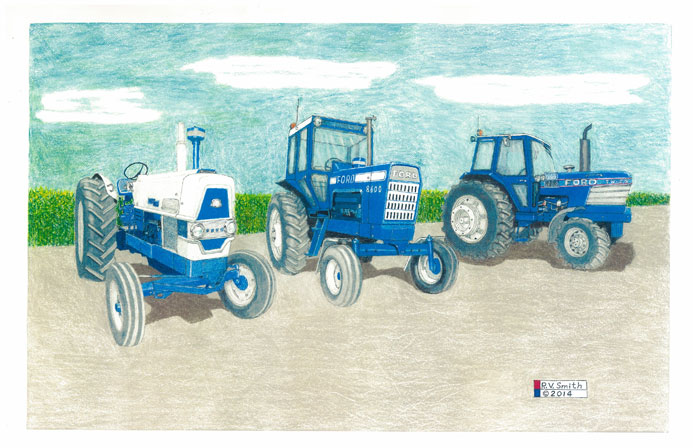
Ford introduced its first successful farm tractor in 1916 and since then has produced hundreds of different models in numerous sizes and powered by gasoline, kerosene, diesel fuel, and LP. Everyone remembers the early Fordsons, the popular 8N's with their innovative hydraulic lifting drawbar, the familiar white 6000's, and the more recent blue models.
- Bob Smith

All of us have experienced an unexpected thundershower during a sultry afternoon in June of July in the upper Midwest. As this farmer is realizing, it is always wise to have sufficient fuel if you are going to be operating at a great distance from the farmyard. Mr. Farmer and his son will be forced to sit this one out under the bale wagon.
- Bob Smith

Minneapolis Moline was a thriving builder of agricultural equipment in the 50’s and recognized by their familiar harvest gold paint. This wire tie hay baler was appropriately named, “The Baleomatic.” They were large, heavy, and complicated for that time with their ingenious wire tying mechanism. In spite of that, many were used by custom operators because the railrolads only accepted wire-tied bales for shipment in those days. Hundreds of them were exported and this scene of one being towed by a Model “Z” could easily have taken place in Australia or New Zealand.
- Bob Smith

At the end of World War II, our long time friend and neighbor, Irvin Suhreptz caught the train to Omaha, purchased, and drove back to Lyon County; one of the first new vehicles I had seen since Pearl Harbor. A brand new bright red Willys Jeep Model CJ2-A. Research reveals that it was one of 71,554 Jeeps that were built at the Toledo Ohio assembly plant in 1946. As a ten-year-old farm boy I was already intensely interested in anything with wheels and an engine. The new Jeep smelled of fresh paint, new rubber, and canvas. I was awestruck by its four-wheel drive capability and the four levers protruding from the floor. We would enjoy riding in it for a number of years as the kind and neighborly Suhreptz’s ferried the Smith kids to catechism classes and other event after storms and during the spring thaw when no other vehicle could tackle the bottomless roads back then. The versatile little vehicle worked hard for many years on the Suhreptz place. Other farmers picked up on Irvin’s innovation and several other Jeeps appears on farms around the area.
- Bob Smith

Charlie Van Abbema, the International-Harvester dealer in tiny Alvord, Iowa delighted in buzzing local farmers as they focused on cultivating the new crop for the first time. The sudden and unexpected noise often caused them to plow out several hills of corn. Those that remember agree it was a miracle he wasn’t shot down.
- Bob Smith
During a special meeting in March of 1934 the stockholders of the Granite Savings Bank made the decision to move their building from the main street of tiny Granite, Iowa to Larchwood, a larger town, a more central location; and to change the name to the Security Savings Bank. It was the only bank in the area that remained open during the Great American Depression. The Henry Brandt Engineering Co. of Sioux Falls was hired to move the 22x42 ft. brick building the 8-1/2 miles over narrow hilly country road. They accomplished this by using two of the largest crawler tractors available at the time and an ingenious block and tackle system. They traveled at the lightning speed of 1/4 mile a day by pulling the bank up to the first tractor and then repositioning everything and repeating the process. They did not dislodge a brick or crack a window, a feat that would be difficult with today's technology and equipment.*
And this proud old company will prosper and grow into the modern successful institution it is today with locations in three states.
- Bob Smith
*From the book, "West Ender's Scrapbook" by Diane M. Johnson, copyright 2004